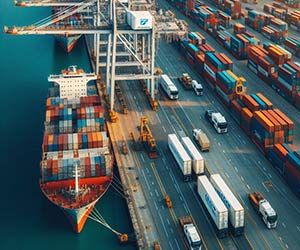


How to choose an ocean shipping line: the criteria that really affect your shipment
Choosing an ocean shipping line means comparing not carrier names but four things: which port the line reliably serves for your cargo, how well it keeps its schedule, how much the whole trip costs with surcharges and free days, and whether space is actually available on the next sailings. For a Ukrainian importer there is a fifth factor — the gateway: direct container calls at the large Black Sea ports are scarce right now, so the box usually travels via Constanța or the Baltic ports and then overland. Below is how to break this choice down and avoid overpaying on details that the first quote hides.
Line, forwarder, NVOCC and alliance: who is responsible for what
The first thing to understand: an ocean line does not guarantee the arrival date. The freight rate is a commitment to carry the cargo, but not necessarily on a specific vessel or on a specific day; the industry calls this a non-guaranteed service. Second: from February 2025 the carriers reorganised into alliances — Gemini (Maersk and Hapag-Lloyd), the Ocean Alliance (CMA CGM, COSCO, Evergreen, OOCL), the Premier Alliance (ONE, HMM, Yang Ming) and MSC, which operates on its own. One line's container often sails on an alliance partner's vessel, so choosing a carrier "by brand" makes no sense — look at the specific service on your trade lane.
Third — whom you pay. If the contract is directly with the line, you hold its bill of lading (Master B/L). If through an NVOCC, it issues its own House B/L. An NVOCC (Non-Vessel Operating Common Carrier) is a contractual ocean carrier without its own ships: it buys space from lines in bulk and resells it to cargo owners under its own responsibility. If through a forwarder, it is your agent: it books the space and includes its own services in the invoice. A direct rate from the line is realistic at large annual volumes; a mid-sized importer is better off working through a forwarder or an NVOCC that holds contract rates with several lines. Who holds the bill of lading determines whom you claim against for loss or damage to the cargo — the party that issued the B/L is liable. As for a delayed arrival, the carrier usually pays no compensation: the schedule is not part of its obligations (a non-guaranteed service), which is one more reason to look at punctuality in advance.
Where the line actually ships: gateways for Ukraine
This is the key question for Ukraine. In 2025 Ukrainian sea ports handled a wartime record of 215,748 TEU — 66% more than a year earlier. The container terminals of Odesa and Chornomorsk are working (KTO, "Brooklyn-Kyiv Port"), and CMA CGM and MSC have returned to them. But the situation is unstable: on 22 July 2026 Maersk temporarily suspended its feeder service to Chornomorsk because of the situation in the Black Sea, switching import discharge to Constanța. So when choosing a line, you first check not "does it ship to Ukraine at all" but through which gateway and how reliably.
According to the Ukrainian Sea Forwarders Association, 40–50% of containers now go via the Baltic ports (Gdańsk, Gdynia) with a short road leg to Yahodyn, the rest via Romania's Constanța. The Danube route (Reni, Izmail), after the restoration of the Greater Odessa sea corridor, dropped sharply: Danube transshipment fell 45.9% in 2024, and Reni by 66%. Choosing a line is largely about which gateway it reaches and what moves the box onward.
| Gateway | Who/how it works | Which region | Leg to Ukraine |
|---|---|---|---|
| Chornomorsk / Odesa | KTO, "Brooklyn-Kyiv", CMA CGM, MSC lines | the whole country | rail to Lviv/Kovel 1–2 days |
| Gdańsk / Gdynia (Poland) | 40–50% of the flow, road/rail | west and centre | road via Yahodyn |
| Constanța (Romania) | transshipment, feeder/barge | south, centre | Constanța–Reni barge ~1.5 days or road/rail |
| Reni / Izmail (Danube) | Viking Alliance terminal | south | rail; to Izmail via Moldova |
Schedule reliability: the main criterion, not the quoted time
The transit time on a line's website is a promise, not a fact. What you really compare is historical punctuality (schedule reliability): the share of vessels arriving within the stated window. In 2026 this figure stayed low worldwide — around 50–65% in different months, and in August it fell to 49.9%, the lowest since 2022. Among individual carriers Maersk usually leads on punctuality, among alliances it is Gemini, and the weakest is Premier.
Line punctuality is measured by independent analytics firms that track tens of thousands of port calls on the main trade lanes. Two are cited most often: the Danish Sea-Intelligence, with its monthly Global Liner Performance report, and the Norwegian freight analytics platform Xeneta. Their methodologies are not directly comparable: Sea-Intelligence counts schedule reliability — a vessel arriving within the planned window — while Xeneta counts on-time arrivals with a tolerance of ±1 calendar day from the original ETA. So do not compare percentages across reports — follow the trend within one methodology. And note the nuance: Gemini's high punctuality comes partly from longer transit times and from avoiding blank sailings. Checking independent analytics such as Sea-Intelligence is more useful than trusting the quoted schedule.
| Alliance | Members | Punctuality guide 2026 |
|---|---|---|
| Gemini | Maersk, Hapag-Lloyd | usually the leader among alliances |
| Ocean Alliance | CMA CGM, COSCO, Evergreen, OOCL | mid-level |
| Premier Alliance | ONE, HMM, Yang Ming | often the weakest |
| MSC (standalone) | MSC | mid-level, wide network |
Transit time and transshipment: direct service vs a hub call
A direct service means the container stays on one vessel from the port of loading to the port of discharge. With transshipment it is unloaded at a hub, held on the terminal for a while and loaded onto the next vessel. Each transshipment adds a few days on average and raises the risk of missing the feeder connection, and for reefer cargo, the risk of temperature deviation. On routes to Ukraine there is essentially no direct ocean service to the Black Sea ports from Asia — the box is transshipped at Constanța or a Baltic port anyway, so here you compare not "direct or not" but how many transshipments and how reliable a given line's connections are.
Blank sailings and rollover: the hidden risk to timing
A blank sailing (a cancelled voyage or a skipped port) is a routine carrier tool: it is used when demand is low to support rates, and also because of port congestion, weather, breakdowns or holidays such as Chinese New Year. For an importer this means a rollover — the cargo is moved to the next available sailing, and the shipment slips by usually 7–14 days, and more on a repeat rollover. A side effect is the risk of demurrage and detention if the shifts burn through the free days. Since the line is not liable for a specific date, there is usually no compensation for such a delay. When choosing a line, look at the frequency of cancellations on your trade and the availability of back-up sailings.
Sailing frequency and space on the vessel
Regularity of service matters more than an attractive transit time on a single voyage. A line with a weekly call gives more flexibility and a buffer against a cancellation than a line sailing once every two or three weeks. Separately, confirm space on the next vessels, especially in peak season and against the backdrop of unstable Black Sea calls: a confirmed booking with a number matters more than a preliminary quote. It helps to refresh the overall flow of the cargo by understanding how ocean container shipping works from port to warehouse.
What the trip really costs: freight, surcharges and free time
A low freight rate is not the same as a cheap trip. The base freight (BAS, Ocean Freight) is only part of the price; on top come surcharges, plus port and free days. So compare offers on an ALL IN basis — the final sum with a full breakdown of what it includes.
- BAF — the bunker (fuel) surcharge, revised regularly in line with the fuel price.
- CAF — the currency adjustment surcharge for exchange-rate swings.
- GRI — a general rate increase the line announces in advance.
- PSS — a peak-season surcharge at demand peaks (for example before Chinese New Year).
- THC — terminal handling at the origin and destination ports; check on which side it sits in the rate.
Separately — the free time and the penalties for exceeding it: demurrage (a container sitting at the port terminal beyond free time) and detention (failure to return the released empty container on time). Free time is often short, and the days are counted as calendar days, so on the Ukrainian leg with a rail transfer it burns quickly. It is worth working out in advance how port charges, demurrage and detention work, and calculating the final cost of carrying a container by sea over the whole chain to the warehouse, not by the rate per kilometre of sea.
 What matters more when choosing a line — price or punctuality?

Why can a cheap rate turn out more expensive?
How many free-time days to allow for?
War risk and insurance on the Black Sea direction
Calls at Ukrainian ports require additional war-risk insurance. In December 2025 the premium per voyage to Ukrainian deep-water ports was estimated at 0.45–0.55% of the vessel's value — well below the 2023 peak of 1.0–1.2%, but still significant; for Constanța and Turkish ports the surcharge is several times lower. War-risk insurance in Ukraine has been available since 2024 and has limits. That is why some lines move to Constanța when things escalate, while separate fees are introduced for Chornomorsk: from 15 March 2026 Maersk applied a congestion fee — 100 dollars for a 20-foot and 200 dollars for a 40- and 45-foot container. When choosing a line, check how its war surcharges work and its fallback scenario if the port closes.
Equipment and container type
The line must provide not only space on the vessel but the right container at the right port of loading. Check the availability of equipment for your cargo — standard 20'/40', high-cube 40'HC, reefer, open-top or flat rack — and its condition. A separate question is whose container it is: COC (the line's equipment, to which its demurrage and detention apply) or SOC (your own or leased container, which is sometimes better for a long delivery and a long rail leg). For reefer and out-of-gauge cargo, a given line's equipment availability often matters more than the rate.
A line-selection algorithm and typical mistakes
To bring it all together, move from the route to the details, not from the rate.
How to choose an ocean line for a specific shipment
A step-by-step breakdown for an importer — a company or sole proprietor in Ukraine.
-
Define the gatewayDecide where it is more convenient to ship — Chornomorsk/Odesa, Constanța or the Baltic ports — for the unloading region.
-
Shortlist lines on the tradeKeep those that run to the needed gateway reliably and often.
-
Compare punctualityLook at historical schedule reliability and the number of transshipments, not just the quoted transit.
-
Calculate ALL INCombine freight, surcharges, THC and free days into a final price to the warehouse.
-
Check space and equipmentConfirm space for the needed date and the availability of the right container.
-
Lock the bookingGet a confirmed booking and agree the free time and the actions if a sailing is cancelled.
Common importer mistakes: choosing by the lowest rate without a breakdown of surcharges; choosing "by a well-known brand" without regard for who actually operates the trade; ignoring free days on a rail leg; relying on old schedules, which on the Black Sea direction go stale within weeks. Trans-Hope selects the line and gateway for the specific cargo, calculates the full trip cost to the door in Kyiv, Odesa, Lviv, Kharkiv or Dnipro, and runs ocean container shipping from booking to discharge. Send the route, volume and cargo type — we will propose a line, a gateway and a transparent ALL IN rate.