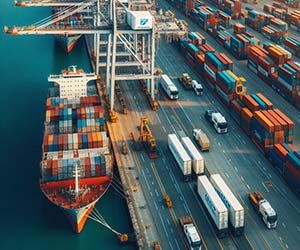
Customs Broker: Who It Is and What It Handles
A customs broker is an enterprise authorised for customs brokerage activity and entered in the register of customs brokers, which under a contract declares a client's cargo and performs customs clearance on the client's behalf. In essence, the broker takes on all the technical and legal burden of crossing the border: it determines the UKTZED code, calculates the payments, prepares the documents, files the declaration and answers customs' queries. Its status is set out in Article 416 of the Customs Code of Ukraine.
The broker's value lies not in filing the declaration itself but in the risks it removes. A wrong code, an incomplete set of documents or a missing certificate turn into cargo standing idle, additional charges, fines and sometimes seizure or spoilage of the goods. The broker structures the clearance so that these scenarios do not arise. Trans-Hope acts as a customs broker in Kyiv, Odesa, Lviv, Kharkiv and Dnipro — at sea, road and air customs posts.
When You Need a Customs Broker and When You Can Do It Yourself
A broker is not always necessary. For a one-off simple shipment a company can declare the cargo itself; but the more complex the goods and the higher the cost of a mistake, the more a broker is justified.
| A broker is justified | You can manage on your own |
|---|---|
| Regular and large shipments | One-off or rare shipments |
| Complex goods: multi-component, excisable | Uniform goods with clear classification |
| Special regimes: temporary import, processing, transit | Simple direct import or export |
| Goods with certification and permit documents | Goods with no permit requirements |
| High cargo value and risk of substantial fines | Small consignment value |
| No in-house foreign economic activity specialist | An experienced declarant on staff |
What a Customs Broker Does: List of Services
The broker supports the cargo at every stage — from preparing documents to release into free circulation. The standard scope includes:
- Goods classification — selecting the 10-digit UKTZED code, which drives the rates and permit requirements.
- Calculation of customs payments — duty, VAT and excise, so the cost is clear before the shipment.
- Preparing and checking documents — reconciling the invoice, contract, transport and permit documents for discrepancies.
- Declaring — electronic filing of the customs declaration and work with the post.
- Support during control — participation in inspection, answering queries, certification.
- Protecting your interests — help with customs value adjustment and appealing unlawful decisions.
What remains with the client: accurate source documents and information about the goods, the actual availability of permit documents, and payment of customs duties to the budget. The boundaries of each party's responsibility are set by the contract.
Direct and Indirect Representation: Who Becomes the Declarant
Ukraine has introduced two types of customs representation modelled on the EU, and who is responsible for paying the duties depends on the option chosen:
- Direct representation — the broker acts on the client's behalf; the client remains the declarant.
- Indirect representation — the broker files the declaration in its own name, becomes the declarant and bears joint and several liability with the client.
The type of representation should be chosen deliberately and stated in the contract — what exactly to fix in it is covered in the article on the contract with a customs broker.
How Much It Costs and Why the "Cost of a Mistake" Is Higher
There are few public price lists for brokerage services: the cost is calculated individually for each shipment. The base rate for processing one declaration is from 100 USD, and the price is then driven by the factors below. State customs payments are calculated separately and go to the budget.
| Factor | How it affects |
|---|---|
| Number of commodity items (UKTZED codes) | More range means a higher workload |
| Complexity and type of cargo | Excisable, permit-controlled and sanitary goods require more work |
| Customs regime | Import, export, transit and temporary import differ in procedure |
| Urgency | Expedited clearance costs more than planned |
| Volume and regularity of shipments | Regular clients get better terms |
Economically, a broker pays off because the cost of a mistake usually exceeds the cost of the service: a single wrong classification leads to additional charges and downtime that are more expensive than brokerage support. A detailed calculation of the service is on the page for the cost of customs broker services.
How to Choose a Customs Broker: Criteria and Red Flags
A mistake in choosing a broker costs as much as a mistake in clearance. What to look for:
- Presence in the register of customs brokers — confirms the right to legally clear cargo.
- Experience with your goods and country — the code is selected faster and more accurately, with fewer risks.
- Transparent pricing and a written contract — a clear price and defined responsibility.
- Readiness for disputes with customs — the broker will support you in value adjustments and appeals.
- Reputation and reviews — real client cases.
Red flags: the company is not in the register; refusal to work under a contract; promises of "grey" schemes and prices noticeably below the market; the absence of clear answers on the code and payments. How to check a company is covered in the article on the register of customs brokers.
 Is it mandatory to work through a customs broker?

How does a broker differ from a declarant?
What is the broker responsible for and what is the client responsible for?
Customs Broker Trans-Hope: Cities and How to Start
Trans-Hope has been operating in foreign economic activity since 2009 and runs the full cycle — from preparing documents and calculating payments to releasing the cargo and, if necessary, appealing customs decisions. Clearance is available at the key logistics hubs: in Odesa — sea container cargo through the ports of Greater Odesa, in Lviv — road import from the EU at the western posts, and in Kyiv, Kharkiv and Dnipro — consolidated, air and road cargo through terminals.
To get started, send the invoice and a description of the goods — a specialist will determine the UKTZED code, calculate the payments and propose a working arrangement.