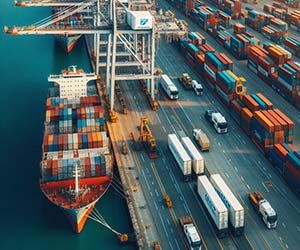


History of container shipping
Until the mid-20th century, cargo was shipped in bulk: every crate, sack and barrel was moved into the hold by hand. Loading a vessel could take a week, and up to a third of a product's cost was eaten by handling. Everything changed thanks to American entrepreneur Malcom McLean: on 26 April 1956 the converted tanker Ideal X left Newark for Houston with 58 identical metal boxes on board. That is how the sea container was born.
In the 1960s the International Organization for Standardization set unified sizes and fittings for containers (the ISO 668 standard). It was standardization that turned the container into the universal “building block” of global logistics: the same box travels on a ship, a train and a truck without being opened. A base unit of measurement also appeared — TEU (Twenty-foot Equivalent Unit), the equivalent of one 20-foot container. Today about 90% of manufactured goods worldwide travel in containers.
Top-7 sea container lines and their fleet in TEU
The global container market is held by a few large shipping lines (ocean carriers). Their capacity is measured in TEU — the total carrying capacity of the whole fleet. Below is an approximate top-7 for 2026; the figures are rounded and change as new vessels enter service.
| Line | Country (HQ) | Fleet, TEU (approx.) | Market share |
|---|---|---|---|
| MSC | Switzerland / Italy | ~6.4 M | ~20% |
| Maersk | Denmark | ~4.3 M | ~13% |
| CMA CGM | France | ~3.9 M | ~12% |
| COSCO | China | ~3.4 M | ~10% |
| Hapag-Lloyd | Germany | ~2.4 M | ~7% |
| ONE (Ocean Network Express) | Japan / Singapore | ~2.0 M | ~6% |
| Evergreen | Taiwan | ~1.8 M | ~5% |
These seven lines account for more than two thirds of the world's tonnage. For a Ukrainian importer the choice of line affects both the transit time and the rate: we work with all the key carriers (MSC, Maersk, CMA CGM, Hapag-Lloyd, ZIM, COSCO) and select the best option for the specific cargo and destination port — more on the sea container shipping page.
Container types: sizes and volume
90% of shipments are standard dry containers (DC) in 20 and 40 feet. But for specific cargo, special types are chosen: a reefer for perishables, Open Top and Flat Rack for oversized goods, a tank container for liquids.
| Type | Internal volume | Max. payload | Best for |
|---|---|---|---|
| 20ft DC (standard) | 28–33 m³ | up to 28 t | dense, heavy cargo |
| 40ft DC | 65–67 m³ | up to 27 t | medium consignments, equipment |
| 40ft HC (High Cube) | 67–76 m³ | up to 26 t | light bulky cargo, textiles, furniture |
| Reefer (20/40ft) | 26–60 m³ | up to 25 t | perishables, pharmaceuticals, food |
| Open Top / Flat Rack | open platform | up to 30 t | oversized, heavy equipment |
| Tank container | 25–35 m³ | up to 25 t | liquids, chemicals |
A practical rule: heavy, dense cargo hits the weight limit — take a 20ft; light, bulky cargo hits the volume limit — a 40ft HC is more cost-effective. Choosing the wrong container type leads either to overloading or to paying for “air”.
What makes up the cost of sea shipping
The final all-inclusive cost is not just freight. It is made up of four blocks: the shipping line's ocean freight, freight surcharges, local port charges (at the port of loading and of discharge) and customs costs in Ukraine (duty, VAT, broker's services). Plus, if needed, the road leg from the port to the warehouse and insurance.
Understanding the cost structure helps compare forwarders' offers: one company gives a low freight rate but “bakes” its profit into local charges, another quotes everything at once. Below we break down each block.
Sea freight: who sets the rate and how
Freight is the shipping line's charge for carrying a container from port to port. The line changes the rate literally every week depending on demand, vessel utilisation and fuel prices. There are two formats: the spot rate (the current market rate, “here and now”) and the contract rate (fixed for several months for large shippers).
The market benchmark is given by indices: SCFI (Shanghai Containerized Freight Index) and FBX (Freightos Baltic Index) — they show the average cost of shipping a container on the main routes and let you tell whether you have been quoted too much or a market rate.
Freight surcharges: BAF, CAF, GRI, PSS, ISPS, war risk
On top of the “bare” freight the line adds surcharges — and it is these that often turn an attractive rate into an unpleasant surprise. The main ones:
| Abbreviation | Full name | What it is |
|---|---|---|
| BAF | Bunker Adjustment Factor | fuel surcharge, depends on the price of bunker fuel |
| CAF | Currency Adjustment Factor | currency surcharge for exchange-rate fluctuations |
| GRI | General Rate Increase | a general rate increase by the line on a route |
| PSS | Peak Season Surcharge | a seasonal surcharge at peak demand |
| ISPS | Ship and Port Facility Security | a charge for ship and port security |
| War Risk | War Risk Surcharge | a war risk surcharge — relevant for the Ukrainian route |
When you request a rate, always clarify whether the price is “all-in” or excludes surcharges. An honest forwarder quotes the full cost at once, rather than adding BAF and PSS after the fact.
THC and port charges
THC (Terminal Handling Charge) is the fee for handling a container at the terminal: unloading from the vessel, movement around the port, processing. THC is paid both at the port of loading and at the port of discharge, and in Ukrainian ports it is usually higher than in Chinese ones. Besides THC there are the documentation fee for the bill of lading (B/L), seal fees, weighing (VGM) and storage. The full structure of port costs is covered in our article on port charges.
FCL or LCL: where the savings point is
FCL (Full Container Load) — you hire the entire container; cargo travels without transshipment. LCL (Less than Container Load) — a consolidated shipment: you pay only for your volume and share the space with other importers. The break-even point is around 12–15 m³.
A simple example: if you have 8 m³, LCL at $150–200 per m³ will cost $1,200–1,600 — cheaper than a full container. But at 16–18 m³ you are already almost filling a 20-foot container, and FCL with a fixed rate becomes more cost-effective, and with no risk of damage at the consolidation point. We ship consolidated cargo under the groupage sea freight (LCL) service.
Consolidating cargo from several suppliers
If you buy from three or four factories in one region of China (for example, in Guangzhou, Ningbo or Yiwu), shipping each order as a separate LCL is not cost-effective. It is cheaper to gather all the batches at one consolidation warehouse, load them into a shared container and clear them with a single declaration. This saves both on freight and on customs clearance, and removes the mismatch in arrival times.
Seasonality of sea freight rates
Sea freight lives by its own calendar. Rates rise sharply before the Chinese New Year (late January — February): factories rush to ship everything before the long holidays and demand for vessels soars. The second peak is August–October, retailers preparing for Christmas sales. In these periods rates rise by 30–80% and vessel space is booked 6–8 weeks ahead. The low season is spring and early summer: if the timeline allows, it is more cost-effective to plan shipment for that window.
Demurrage and detention: how not to hand money to the line
Two charges on which importers lose money for nothing. Demurrage is a charge for the container standing in the port beyond the free time (usually 7–14 days), $25–80 per day for a 20ft. Detention is a charge for using the container after it has left the port beyond the allowed period. Both are applied automatically by the line.
The trick is simple: documents must be ready before the vessel arrives, and the customs declaration submitted in good time. Then clearance fits within the free time and the clock does not start. We track the ETA and alert the client 5–7 days before the container arrives.
Direct service or transit via Constanta and Gdansk
From China to Ukrainian ports (Chornomorsk, Odesa, Pivdennyi) a container goes by direct service, or with transshipment at a European hub and from there by road to the final destination in Ukraine. Constanta (Romania) is the main hub for Ukraine: a deep-water port from which cargo moves by road or feeder. Gdansk (Poland) is the northern corridor, convenient for cargo destined for western Ukraine. A direct call at a Ukrainian port is usually faster, while transit via a hub is sometimes cheaper or the only option available in the event of force majeure such as hostilities. The optimal option is calculated for each cargo.
Cargo insurance: how much it costs and when it is essential
A sea voyage means storms, transshipments and other people's hands at consolidation points. A cargo policy costs on average 0.2–0.4% of the cargo value, and covers up to the full value in case of damage or loss. The standard terms are the ICC clauses (A/B/C), with the insured sum usually CIF + 10%. Without a policy, compensation in case of loss is virtually impossible. When and how to insure cargo — in our separate article on cargo insurance.
Tracking where your container is now and when it will arrive is done by tracking by number — there is a separate article on this: how to track a container by number.
7 legal ways to cut the cost of sea shipping
We have put into a checklist everything that really saves the budget without “grey” schemes:
- Calculate FCL and LCL in parallel — at a volume of 15 m³ or more, a full container is usually cheaper.
- Consolidate orders from several suppliers into one container.
- Plan shipment outside the peak seasons (not before the Chinese New Year).
- Ask for an “all-in” rate and check it against the SCFI/FBX indices.
- Prepare documents in advance — that way you do not pay demurrage and detention.
- Confirm the HS (UKT ZED) code and the duty rate before shipment, not at clearance.
- Choose the right Incoterms — they determine who pays for freight and insurance: see Incoterms in sea shipping.
 What is TEU?