


A commercial invoice is one of the key documents in international trade. Its importance is hard to overestimate: it records the parameters of the transaction, simplifies customs procedures and protects the interests of both parties. However, to use the invoice as effectively as possible, you need to understand exactly what it is, why it is needed and how to draw it up correctly.
What is a commercial invoice?
A commercial invoice is a document drawn up by the seller and handed to the buyer. It confirms the fact of the sale of the goods, describes the details of the transaction, and is also the basis for customs calculations and accounting.
An invoice can be issued in both paper and electronic form, but in any case it must be signed and have legal force.
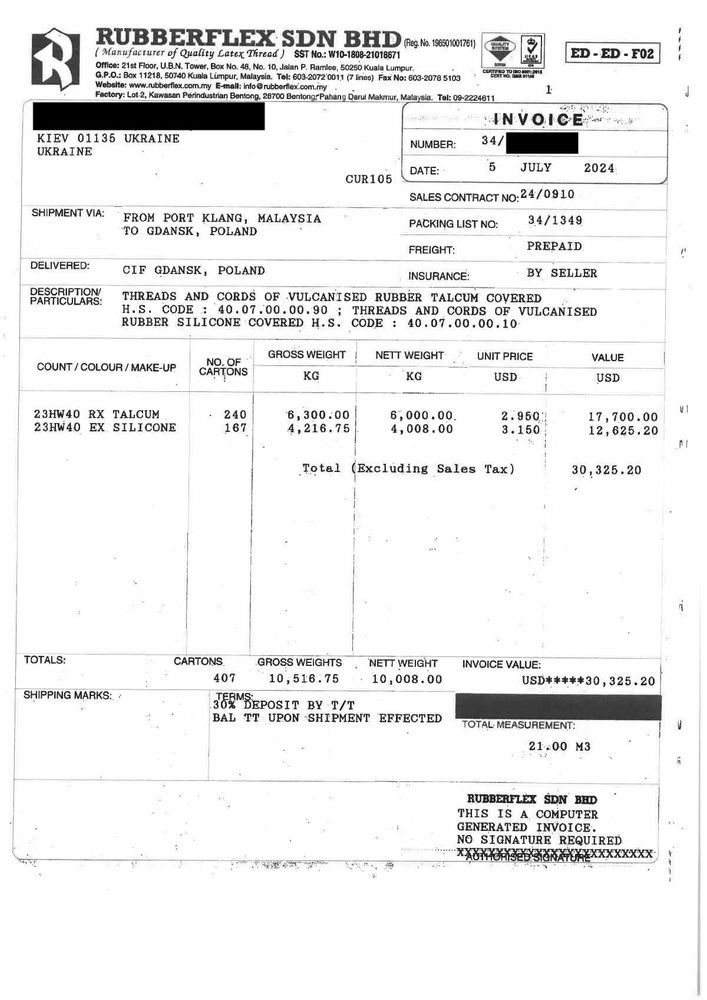
The main functions of a commercial invoice
- Customs control: helps the customs authorities determine the amount of duties and taxes, and check that the cargo matches the declared data.
- Accounting: serves as confirmation of the transaction for both parties, and is used to record operations and prepare financial statements.
- Legal protection: records the terms of the transaction and is a basis for resolving disputes.
- Logistics: contains the information carriers need, including a description of the cargo, its weight and value.
Why is a commercial invoice needed?
In the process of international trade a commercial invoice is indispensable, because it allows you to:
Speed up customs clearance.
Avoid misunderstandings between the parties to the transaction.
Confirm the legality of the origin of the goods.
Correctly calculate the transport and tax costs.
How to draw up a commercial invoice: structure and mandatory fields
For the invoice to be accepted by all parties and controlling authorities, it must contain the following mandatory fields:
Mandatory elements:
The full details of the seller and the buyer (name, address, contacts).
The date and number of the invoice.
A detailed description of the goods: name, quantity, unit price, total value.
The delivery terms (for example, FOB, CIF, DDP).
The country of origin of the goods.
The total amount of the transaction, with the currency indicated.
A signature and, if necessary, a stamp.
Recommended elements:
The customs code of the goods (HS Code).
Payment terms (for example, "30 days after receipt of the goods").
Transport details: container number, method of delivery, ports of departure and arrival.
Additional elements:
Information about the certification of the goods.
A mention of the packaging: number of packages, gross and net weight.
Notes: information about guarantees, returns or the specifics of the goods.
Important aspects of working with an invoice
The difference from other documents
It is important not to confuse a commercial invoice with a proforma invoice. A proforma invoice is a preliminary document provided to the buyer before the transaction is concluded. It serves only to familiarise the buyer with the prices of the goods and is not legally binding.
Electronic commercial invoices
With the development of technology, the popularity of electronic invoices is growing. They provide faster processing, are convenient to store and are protected from forgery. The use of an electronic invoice also helps to speed up customs clearance.
Tips for beginners
- Use templates: many companies provide ready-made forms that can be adapted to your needs.
- Watch the accuracy of the data: any error can lead to delays at customs or to fines.
- Provide a translation: if the recipient country requires documents in its own language, provide them in two languages.
- Duplicate the document: always keep copies of invoices in both paper and electronic form.
- Follow the requirements of the importing country: different countries may have specific requirements for drawing up invoices.
Interesting facts about the commercial invoice
- Multifunctionality: in some countries the commercial invoice is also used as an import declaration.
- The invoice as an element of taxation: it plays a key role in checking the legality of a transaction and calculating taxes.
A commercial invoice is not just a formality, but a crucial tool in international trade. Drawing it up correctly allows you to avoid a lot of problems at the delivery and customs clearance stage. If you are just starting out in international trade, pay special attention to drawing up this document — it will save you time, money and nerves.
Be careful, follow the standards and trust only professionals!