


Image is nothing — what matters is how well you cleared your goods!
Now we are going to talk about how you can clear goods through customs.
Broadly speaking, you have two paths for clearing purchased goods. The first is the easiest, and that is its advantage. It is to deliver the cargo through a CARGO company. And a question immediately arises: how do these cargo companies work? You go to Google and type "customs clearance of goods from China Moscow", "customs clearance from China Kyiv", and so on. You call them and say: I bought 30 round kitchen tables, on FOB Shanghai delivery terms. The total value of the goods is USD 800, net weight 450 kg, gross weight 480 kg, volume 5 m³. A small remark on how net weight differs from gross. Net is the weight of the goods themselves without packaging, and gross weight is the total weight of the goods including packaging (the weight of the box, the polyethylene, the foam, the weight of the wooden pallet if the cargo is palletised). For the official calculation of customs payments you need to know the net weight. But for clearance through cargo companies you need to know and state the gross weight. And then you ask the cargo company's manager how much it will cost to deliver such a consignment of goods from Shanghai to Moscow, Kyiv, Odesa, Novorossiysk including clearance. And the guys answer you that for such goods delivery by sea within 40 days including clearance will cost, for example, USD 3 per kg, or for example USD 5 per kg. For each type of goods they give their own price per 1 kg (for example, USD 3/kg to clear tableware, USD 5/kg to clear electronics). That is, if you were quoted a delivery + clearance cost of USD 3 per kg, then you multiply your 480 kg by USD 3 and it turns out that delivery and clearance of such goods will cost you USD 1,440. You call around 10 such companies, choose the ones that seemed most interesting to you by the combination of factors — service price and reasonableness of communication. And you start working with them. The manager from this firm will ask you for the contacts of your sender (your seller). And will give the contacts of the warehouse in Shanghai where the seller must bring and hand over the goods. When your seller brings the goods to the warehouse in Shanghai, the seller is given the number of your shipment; the seller tells you this number, and then with this number you will call the cargo firm's manager and ask how the delivery and clearance of the goods is progressing — in fact, you cannot do anything else except humbly call the manager and ask: well, when will I be able to collect my goods? Well, when will I be able to collect my goods? Because cargo companies do not conclude any contracts for the delivery and clearance of cargo. You work on trust, and if something happens to this cargo firm, you will have no one and nothing to make a claim against, and you must understand that no one is to blame — you yourself chose this path because it is simpler in structure and sometimes cheaper compared with official clearance. Cargo is working with the pirates of the 21st century. It is your choice whether to work with cargo or not. And we by no means try to talk you out of working through cargo companies. Everyone is master of their own choice. We will say more: most beginner entrepreneurs go the cargo route. And then they write plaintive reviews that they waited for the cargo for 3 months, went grey in the process, or worse, lost the cargo entirely. Here is a link to a juicy thread of reviews of Russia's most famous cargo company — Transit Plus, by Dima Portnyagin, the author of the Transformator channel on YouTube; you've probably already watched it?)
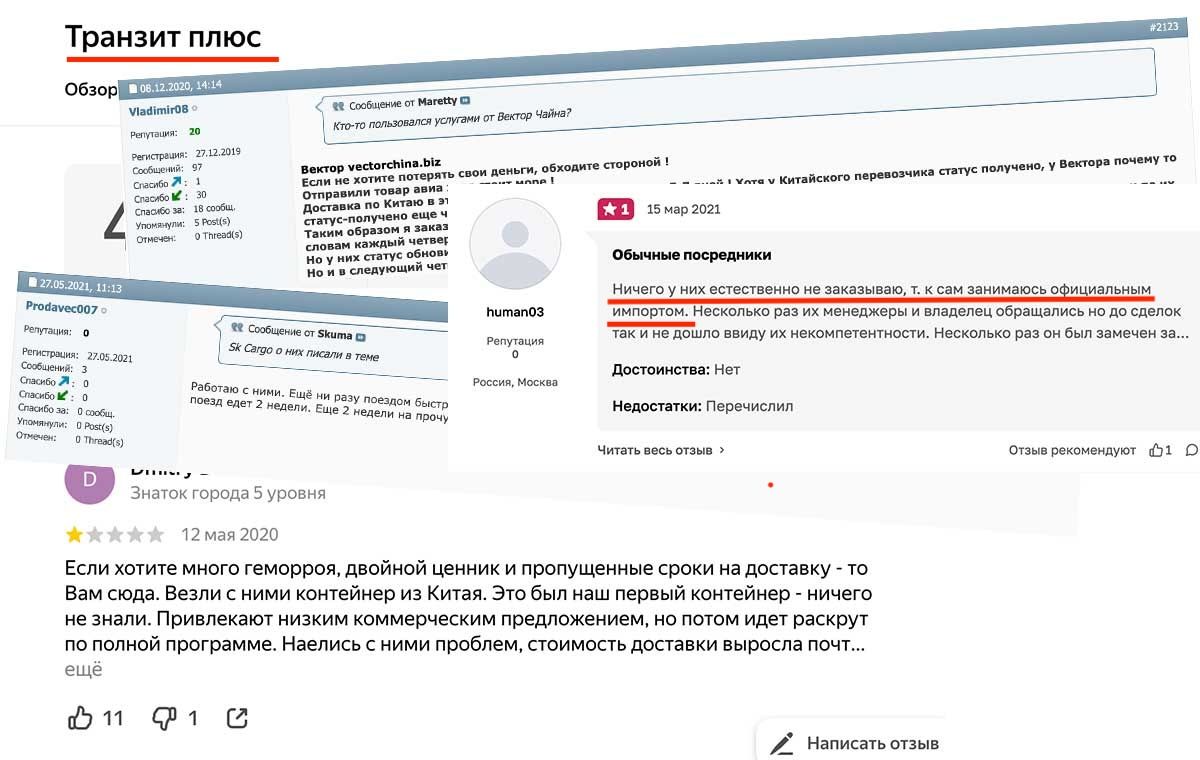
Broadly speaking, we decided to write this post because the internet is full of videos about how easy it is to bring in and clear goods (you hand over the goods in Shanghai, receive them in Moscow or Kyiv) — "we will take care of all the delivery and clearance, don't worry, everything will be fast and cheap" — only no one says that all these companies never conclude service contracts with their clients, do not provide incoming documents for the goods and will never give you a copy of the customs declaration, because the goods are often cleared "grey".
Let's discuss how grey clearance differs from black clearance. Black is when the goods are hidden in the vehicle and are not declared to customs at all, but there is not much of such a flow; mostly it is grey clearance, which is when inaccurate information about the characteristics of the goods and their weight is submitted to customs. For example: you bought 1,000 kg of leather shoes worth USD 10,000, but customs is told that 500 kg of imitation-leather shoes worth USD 2,000 arrived. You understand that the cost of the payments to the budget for 1,000 kg of leather shoes and 500 kg of imitation-leather shoes will differ many times over. But don't think you will be able to save 2–3 times on the payments. The guys at the cargo companies can perfectly well calculate how much official clearance would have cost you and give you a total delivery and clearance price 20–30% cheaper than official clearance. They keep all the rest of the profit for themselves. And our young beginner entrepreneur thinks: that's it, I've hit the jackpot. I'll bring in and clear goods 30% cheaper than that fool who imports officially, I won't have to bother with selling at all, at such a price my goods will be snapped up, I won't have to do product promotion or handle objections — I'm cool, I'm the smartest.
And so it goes once, twice, three times, even 10 times, and on the 11th time we see in the news that yet another consignment of contraband has been detained and so many tonnes of goods seized. That's it, the comedy is over — good if you are lucky and got caught on the 10th clearance and, thanks to what you saved, came out overall in the black; but what if they nabbed you on the third supply? Do we go back to the factory, to the machine?
That is why we suggest looking towards official clearance. Yes, it is a bit more complicated, but "more complicated" is when you haven't tried it and don't know; in the following posts we will lay out all the nuances of official clearance in plain terms. And perhaps it will be a revelation to you now, but official imports are many times greater than the grey clearances done by cargo companies. If you look at the statistics of customs clearances, the tonnage of goods imported "white" is tens of times greater than grey imports. You will ask: how do we tell where it is white clearance and where it is grey? Elementary — if you look at a clearance firm's statistics and its list contains, for example, only tables and interior items, and it has a website dedicated to furniture and interiors, then it is a white company; but if a firm has no website, clears tables and tractors and computers and perfume and garden tools, and was registered half a year ago, then it is a grey little firm that will soon disappear.
Now we will tell you in a couple of words how to import officially and how to calculate the cost of clearance. Everything is the same, only you type in Google: Customs broker Moscow, customs broker Kyiv, Customs broker Odesa, customs broker Novorossiysk — in short, you choose the large city geographically closest to you. If you live in a remote area, it is better to clear directly at the port. You call a logistics or broker company. A logistics company does the whole package — both delivery and clearance — however, there are also broker companies on the market that do only official clearance without delivery. And it is normal that you will import through one company and clear through another, but for the first time we would recommend turning to a logistics company so that they do the whole package of services for you. And exactly as you called the cargo company, you say: I bought 30 round kitchen tables, on FOB Shanghai delivery terms. The total value of the goods is USD 800, net weight 450 kg, gross weight 480 kg — could you please arrange delivery of the cargo to the port of Novorossiysk / Odesa as part of a groupage container? If they answered YES, you say: please calculate the rate for delivery. The guys will calculate how much the transport will cost. And if you are importing to Ukraine, you can contact us and we will calculate the cost of delivering your cargo. The next stage will be to calculate the cost of the customs broker's work. You ask how much the broker's service for compiling and completing the customs declaration will cost. They will most likely say they need to see how many goods there are and what goods; you reply: I have an invoice and a packing list, what email should I send them to. You send the documents to the broker and they will assess the cost of their work. We'll tell you a secret: you may be quoted a cost for clearing 30 tables of USD 200 and USD 300. But that is exactly why you are reading this post — to learn all the nuances of how to buy, bring in and clear goods at the optimal price, while making a minimum of mistakes. It cannot be said that this is our main job, but Trans-Hope has repeatedly supported and advised entrepreneurs at every stage during their first supplies, when, before taking the next step, the entrepreneur calls and says: I'm going to do such and such, is that right? We answer: you can do it that way, but we would recommend doing it this way. And the person makes the final decision. In the following posts we will tell you what an honest price for a broker's work is and, most importantly, how to structure the conversation with the broker so that they calculate the projected payments to the budget for taxes, namely: on clearance we always pay VAT and duty to the budget. But that is a separate topic for the next post. Take part in the life of this Blog, ask questions in the comments…