

Business with China: where an importer starts
China remains the world’s main factory and a core source of goods for Ukrainian business — from electronics and clothing to equipment and building materials. But between the idea of “importing from China” and real profit lies a chain of choosing a niche, finding a factory, the contract, payment, logistics and customs clearance. A mistake at any stage eats into the margin. Below is a step-by-step guide for legal entities and sole proprietors who are starting from scratch and want to work legally.
Step 1. Choose your business model
There are three working models. The first is direct import for resale: you buy finished goods from a manufacturer and sell them in Ukraine. This is the most common and straightforward format for a start. The second is brand distribution: you become the official representative of a Chinese company. The third is buying raw materials and components in China with production or assembly in Ukraine. For a first attempt, import for resale is almost always chosen: a short chain, a quick demand test, minimal commitments.
Decide on your business form right away — sole proprietor or LLC. It determines taxation, the ability to work with VAT, the bank’s requirements for currency transactions and the volume of reporting. Import for business is conducted on behalf of a foreign-trade entity, so “importing commercial batches as an individual” is a dead end.
Step 2. Assess the niche and economics before finding a factory
A beginner’s main mistake is to first find a “great product” and only then count the money. The correct order is the reverse: first analyse the niche and unit economics, then look for a manufacturer. Look not at what you want to sell but at what already sells: demand, revenue and competitors’ margins. The target gross margin after all costs — delivery, customs clearance, commissions, storage — should stay at no less than 30–40%.
Consider turnover: a slow-moving product freezes working capital. Assess weight and volume relative to price — light but bulky goods are expensive to ship (“volumetric weight” applies). And check in advance whether the goods will require permits: cosmetics, medicines, children’s and food products need certification, and such categories are best avoided at the start. Calculate the break-even point per batch before your first message to a supplier.
Step 3. White import vs. “cargo”
Goods from China are shipped two ways: officially (“white”) and via “cargo” — a grey scheme where the goods travel anonymously and are cleared using understated or “grey” documents. Cargo is cheaper by exactly the cost of legal clearance, but the price of the saving is risk: confiscation, fines, no input VAT and “dirty” documents that will not pass an audit.
For a legal entity or sole proprietor, white import is almost always more advantageous over the business horizon: you get an input VAT credit, a transparent cost base and peace of mind during inspections. That is why the rest of this guide is built around legal import.
Step 4. Where to look for a supplier
The main platforms: Alibaba (exporters, English interface, Trade Assurance protection), 1688 (China’s domestic wholesale market — lower prices, but a Chinese interface and “internal” payments, usually via an agent), Made-in-China and Global Sources (more direct factories). A live channel is exhibitions: the Canton Fair in Guangzhou and industry expos, as well as the wholesale markets of Yiwu, Guangzhou and Shenzhen.
Distinguish a factory from a trading company (trader) right away. A factory has a lower price but a higher MOQ and a narrower range; a trader is more expensive but more flexible on volume and more convenient on service. Collect several quotations from different suppliers — this gives a basis for comparing prices and terms.
Step 5. Vet the supplier before prepayment
Alibaba badges — Gold Supplier, Verified Supplier, Trade Assurance — are useful, but they are not a factory audit, just paid statuses and a basic platform check. Dig deeper: the company’s business licence (and whether its name matches the bank account details), time on the market, deal history, export experience to Ukraine and the EU, the authenticity of certificates. For a large deal, order a video walkthrough of the workshop or a third-party factory inspection.
Red flags: a suspiciously low price, pressure to “pay urgently”, refusal to provide samples and — most importantly — a request to transfer money to an individual’s card or a payment system. Pay only to the company bank account stated in the business licence. Separately re-check the details before payment: substituting the bank account in an email is a classic fraud scheme. We cover the detailed vetting algorithm in a separate article — how to vet a Chinese supplier before prepayment.
Step 6. Samples, specifications and MOQ
Never order a large batch without samples. Approve the sample you receive as the “reference” and keep it — it will be the main argument in a quality dispute. Draw up a written technical specification: materials, dimensions, colour, packaging and labelling. If you need goods under your own brand, discuss OEM (your logo on the supplier’s product) or ODM (the factory’s ready design under your brand).
MOQ (minimum order quantity) is almost always negotiable. It can be reduced with a surcharge for the batch, a mixed order of several items or a promise of repeat purchases. In negotiations, remember the culture of “saving face”: a Chinese “yes” often means “I hear you”, not agreement. Set out the acceptable defect rate (AQL) and the right to inspect before shipment.
Step 7. The foreign trade contract and payment
The arrangements should become a formal foreign trade contract — a working document you can appeal to. It records the subject and specification, price and currency, deadlines, Incoterms, the acceptance and quality procedure, force majeure, claims and arbitration, and bank details. The invoice is the basis for the customs value; the data in all documents (contract, invoice, specification, payment) must match, otherwise the bank will refuse the currency transaction.
On payment, currency control applies in Ukraine (Law No. 2473-VIII and NBU rules): the maximum settlement period for a foreign trade operation is 180 days, a penalty is charged for a breach, and the bank acts as a currency supervision agent. Settlement formats: a bank SWIFT transfer (T/T) and a letter of credit (L/C) — for first and large deals a letter of credit is safer, as the money goes to the seller against documents. A typical scheme is a 30% advance and 70% against a copy of the bill of lading, but the terms are negotiable. To operate, open a foreign-currency account for foreign trade.
Step 8. Incoterms: who is responsible for what
Incoterms 2020 allocate costs, risks and obligations between seller and buyer — and directly affect the customs value. The key ones for China:
- EXW — minimum seller obligations; pickup from the factory and export clearance fall on you in China. Inconvenient for a beginner.
- FCA — the seller hands the cargo to the carrier and handles export; more convenient than EXW for container shipping.
- FOB — the seller loads the goods on board at a Chinese port and handles export; you pay freight, insurance and import. A popular option for containers.
- CIF/CFR — the seller pays freight (and insurance too under CIF) to the port of destination.
- DDP — the seller takes on everything, right up to import customs clearance. Maximum convenience, but more expensive and you lose control over clearance.
For a start, a reasonable balance is FOB or FCA: you control logistics and customs clearance yourself (or through a freight forwarder) rather than handing them over blindly.
Step 9. Choose the delivery method
Choosing transport is always a balance of “price vs. time”.
| Method | Time | Cost | When to choose |
|---|---|---|---|
| Sea (FCL/LCL) | Slow | Low | Large batches, stable volumes |
| Rail | Medium | Medium | A compromise of price and time |
| Road | Medium | Medium | Flexible door-to-door delivery |
| Air | Fast | High | Samples, urgent and valuable cargo |
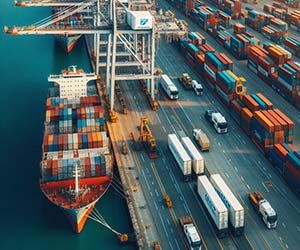
A practical rule: samples by air; the first batch for sale by groupage (LCL) or rail; with stable volumes, by full container (FCL). A multimodal scheme is often optimal: by sea to the port, then by road or rail to the warehouse — under a single contract with a freight forwarder. Containers from China are received by the ports of Odesa, Chornomorsk and Pivdennyi, as well as European hubs (Gdynia, Constanta) with onward delivery by road or rail to Kyiv, Kharkiv and Dnipro. We handle turnkey sea container delivery ourselves — from booking to release from the port: sea container freight. Budget a buffer for possible demurrage (a charge for container idle time) and for cargo insurance.
Step 10. Customs clearance in Ukraine
A commercial batch for a legal entity or sole proprietor is cleared with a customs declaration regardless of the amount — the €150 duty- and VAT-free threshold applies to individuals’ parcels, not to commercial import. Payments on import: import duty (from 0 to 20% depending on the goods code), 20% VAT and, for certain goods, excise. Important: VAT is calculated not on the “bare” price of the goods but on the invoice value plus delivery to the border plus duty.
The duty rate, VAT and the list of permits are determined by the UKT ZED code — an error in classification changes the amount of payments and can lead to fines. The document package: contract, invoice, packing list, transport documents (bill of lading/CMR) and, if needed, certificates of origin, conformity, SES, phytosanitary or veterinary documents. A separate risk is a customs value adjustment (CVA), when customs doubts the price; prepare an evidence base in advance (price lists, bank payment documents and, if needed, a price expertise). Selecting the code, calculating payments and declaring are best entrusted to a specialist — a customs broker.
Step 11. Calculate the full landed cost
A common mistake is to count only the purchase price. The real cost of the goods at your warehouse is made up of the supplier’s price, international delivery, insurance, customs payments (duty + VAT + possible excise), broker and freight-forwarder services, bank commissions and internal logistics. Only this figure is the basis for pricing and margin assessment. How to build it by a formula and not forget the hidden items — in a separate article: how to calculate the full landed cost of goods from China.
Step 12. Quality control
Professional control is built on three points: a check before the order is launched, an inspection during production and a check before final payment/shipment. The inspector compares the batch with the reference sample and checks conformity to dimensions, weight, quantity, and the correctness of labelling and packaging. A report with photos and video is a real argument in negotiations: if a defect is found, the supplier can be required to rework the batch, replace defective units or reduce the price. The acceptance terms (AQL, the right to inspect before shipment, the procedure for defects) should be set out in the contract in advance.
Step 13. The first order step by step
How to run your first deal with China
The procedure for a first import deal with China — from niche analysis to accepting the goods.
-
Analyse the nicheDemand, competitors, a target margin of at least 30–40%.
-
Find suppliers3–5 options on Alibaba, 1688, Made-in-China, at exhibitions.
-
Vet the supplierBusiness licence, history, certificates, bank details.
-
Order samplesApprove the reference and the technical specification.
-
Sign the foreign trade contractPrice, Incoterms, quality, deadlines, details.
-
Pay under the contractThrough a bank, taking currency control into account.
-
Arrange deliveryChoose the transport and a freight forwarder.
-
Clear customsUKT ZED code, payments, documents, broker.
-
Accept the goodsCompare with the reference, file claims for defects.
Step 14. Test batch and scaling
A working route: test with a small batch (100–200 units) → analyse unit economics and turnover → a repeat, now larger order → move to a full container (FCL) and direct contracts → expand the range and, if desired, your own trademark. Do not order a large batch at the peak of a fading trend, and do not scale until the economics of the first shipment are confirmed by numbers.
Common beginner mistakes
- Did not vet the supplier before transferring the advance.
- Ordered without a written specification and without samples.
- Drafted the contract poorly (no quality, force majeure, arbitration).
- Counted only the purchase price, not the full landed cost.
- Got the Incoterms wrong — “caught” unexpected costs and risks.
- Understated the value at customs — got a CVA and fines.
- Did not allow for Chinese holidays (New Year, “Golden Week”) and missed deadlines.
- Paid to an individual’s card instead of the company account.
Frequently asked questions
 What amount should I start a business with China with?

Does a beginner need a customs broker?
How is white import better than cargo?
What currency should I pay the supplier in?
Turnkey import from China with Trans-Hope
Trans-Hope supports business at every stage of import from China: delivery by sea, rail, air and road, port forwarding, UKT ZED code selection, calculation of payments, customs clearance and delivery to your warehouse in Kyiv, Odesa, Kharkiv or Dnipro. Send a description of the goods and the volume — we will calculate a delivery and customs clearance scheme for your project.