EUR.1 certificate of origin
The European EUR.1 certificate of origin of goods is a document that confirms the status of goods as having preferential origin in accordance with the international ASSOCIATION AGREEMENT between Ukraine and the European Union. To obtain this certificate you need to apply to the relevant unit of the State Customs Service of Ukraine and submit the required set of documents.
Obtaining the EUR.1 certificate: the certificate can be obtained through a personal visit by the exporter to the State Customs Service, by submitting an application for a EUR.1 certificate of origin electronically by email, or through a legal representative (a customs broker). The following may apply for a EUR.1 certificate: individuals, legal entities, and individual entrepreneurs.
Documents required to obtain the EUR.1 certificate: To obtain a EUR.1 certificate of origin, the exporter or an authorised representative must submit the relevant documents to the structural unit of the customs office responsible for issuing the certificate.
The list of documents for obtaining a EUR.1 certificate of origin includes:
An application containing a declaration from the exporter (hereinafter — the application), in accordance with the form defined by the Agreements, or its electronic copy.
An electronic copy of the completed EUR.1 certificate, if it is completed by typewriting.
A declaration from the supplier (manufacturer) of goods that have preferential origin status (annex 1), or a declaration from the supplier (manufacturer) of goods that do not have preferential origin status (annex 2), or a long-term declaration from the supplier (manufacturer) of goods that have preferential origin status (annex 3), or a long-term declaration from the supplier (manufacturer) of goods that do not have preferential origin status (annex 4) (hereinafter — the declaration), which confirm the preferential origin of goods from Ukraine in accordance with the rules for determining preferential origin established by the intergovernmental Agreements.
For subsequent supplies of the goods, the submission of the supplier's (manufacturer's) declaration is not mandatory if, at the first supply, a long-term declaration was submitted from the supplier (manufacturer) of goods that have preferential origin status, or a long-term declaration from the supplier (manufacturer) of goods without preferential origin status.
The declaration must be personally signed by the supplier (manufacturer) who drew it up. However, the supplier (manufacturer) may refrain from signing the declaration if they submitted it in the form of an electronic document and gave the exporter written permission to be responsible for all declarations in which their name is indicated as the signatory.
Conditions and provisions for issuing the EUR.1 certificate of origin: the EUR.1 certificate of origin is issued in cases where this certificate must be presented as confirmation that the goods meet the requirements of the rules for determining preferential origin defined by international agreements, when preferential duty rates are applied on import.
The EUR.1 certificate is issued by a customs official when the goods are exported, during their customs clearance, or after the export of the goods in the cases provided for by international agreements, at the place of the goods' customs clearance or at the place of the exporter's state registration.
The EUR.1 certificate of origin may be issued after the export of the relevant consignment of goods if the exporter additionally submits to customs documents confirming:
That the certificate was not issued at the time of the goods' export due to errors or special circumstances, or
That it was issued but was not accepted for technical reasons by the customs authorities of the importing country.
In the exporter's application for the issue of the certificate after the export of the goods, the number of the export declaration for the relevant consignment of goods and the date of its completion at customs must be indicated.
Timeframes and cost: the EUR.1 certificate of origin is issued within 8 hours of the moment the application for the issue of the certificate is submitted, free of charge.
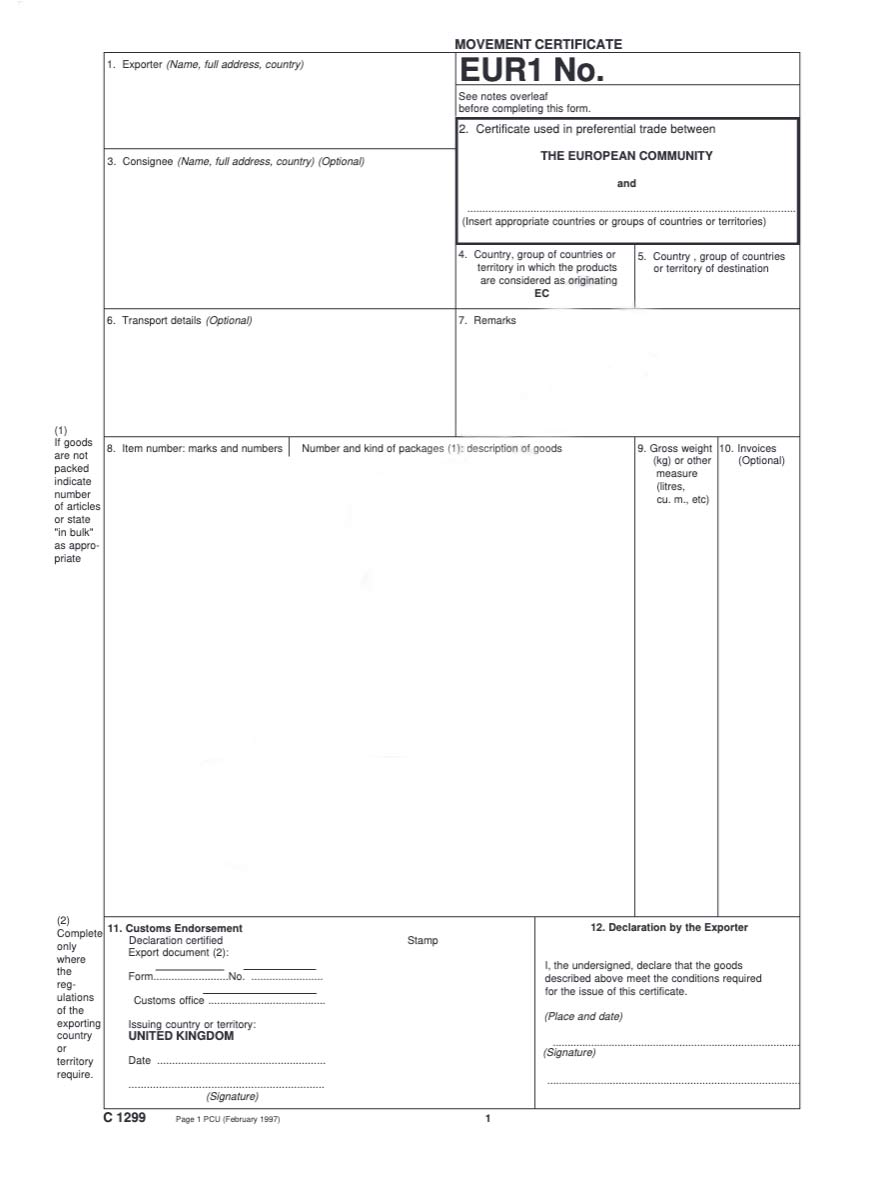
Example of a EUR.1 certificate
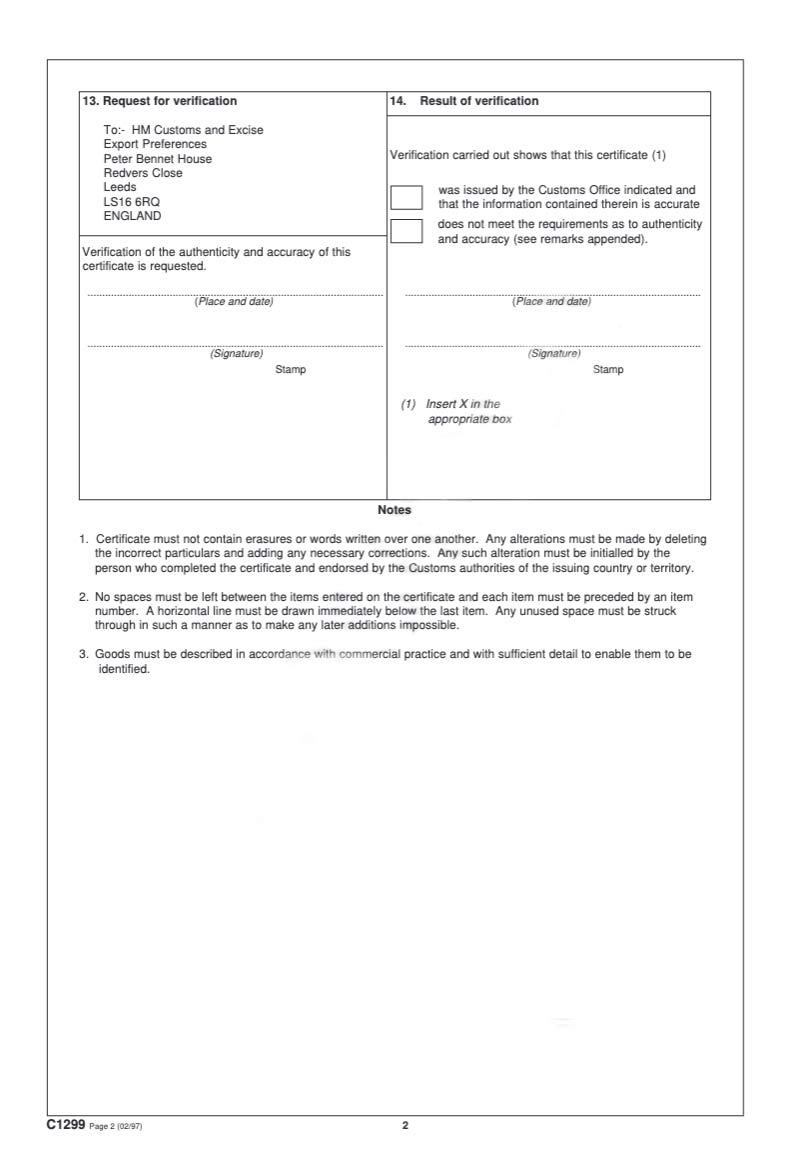
Reverse side of the EUR.1 certificate
Completing the EUR.1 certificate:
The certificate is drawn up in one of the languages in which the relevant agreements are concluded, and in accordance with the rules of Ukrainian legislation, by typewriting or in printed letters by hand in ink. All pages of the certificate must be completed in the same way, clearly and neatly. There must be no corrections on the certificate or words written over other words. When making changes, the incorrect information is crossed out and the correct information is added. Changes to the correct information must be made by the exporter or their authorised representative who drew up the certificate, and certified by the seal of the official of the structural unit of the customs office responsible for issuing the certificate (hereinafter — the customs official).
The certificate is drawn up for one consignment of goods being exported.
Boxes 1, 2, 4, 5, 8, 9, 12 of the certificate are mandatory for the exporter to complete on the front of the certificate. Boxes 3, 6, 10 of the certificate are completed at the exporter's discretion on the front of the certificate.
Boxes 7, 11 are completed by the customs official on the front of the certificate.
Box 13 is completed on the reverse of the certificate by the customs authorities of the goods' importing country in the event that the certificate is sent for verification (a check of authenticity) and confirmation of the preferential origin of the goods.
Box 14 is completed on the reverse of the certificate by the central executive authority implementing state policy in the field of state customs matters, following the verification (check of authenticity) of the certificate at the request of the customs authority of the goods' importing country.
The certificate number, consisting of letters and nine digits, is completed by the customs official on the front of the certificate in the top right corner according to the following scheme:
No. A XXX.MMMMMMMM,
where A is an unchanging symbol;
XXX are the first 3 digits of the code of the customs office that issued the certificate, according to the Classifier of the SFS, the SFS customs offices and their structural units, approved by the central executive authority implementing state policy in the field of state customs matters;
MMMMMMMM is the serial number of the certificate, which is assigned in ascending order starting from one. Each customs office keeps a separate numbering of the certificates it has issued.


